投稿系统
投稿系统


Challenges and optimization of prenatal diagnosis in cold regions: Combined application of karyotyping and CNV-Seq with seasonal compliance analysis
doi: 10.1515/fzm-2026-0011
-
Abstract:
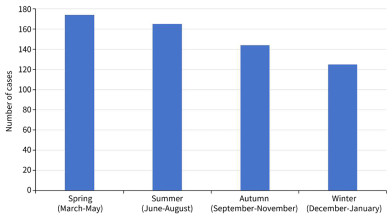
Objective Prenatal diagnosis in cold regions faces distinctive challenges related to extreme cold climatic conditions, which can substantially reduce healthcare compliance among pregnant women and limit the accessibility and accuracy of local prenatal diagnostic services. However, targeted research on region-specific diagnostic barriers and optimized combined detection strategies remains insufficient. This study systematically investigated the unique challenges of prenatal diagnosis in cold regions, with particular emphasis on the impact of harsh climatic conditions on healthcare compliance among pregnant women and evaluated the clinical utility of integrating chromosomal karyotyping with copy number variation sequencing (CNV-seq). Methods A retrospective analysis was conducted among high-risk pregnant women over a two-year period. Seasonal differences in prenatal clinic attendance were statistically analyzed to identify key barriers affecting healthcare compliance. Additionally, the clinical efficacy of combined chromosomal karyotyping and CNV-seq was systematically evaluated. Results Retrospective analysis of high-risk pregnancies revealed a statistically significant decline in winter clinic attendance (χ2 = 9.51, P < 0.05) over the two-year period, mainly associated with transportation difficulties, concerns regarding nosocomial infection, and local cultural practices. The combined use of chromosomal karyotyping and CNV-seq demonstrated complementary diagnostic value. Karyotyping identified 12 balanced translocations, 23 sex chromosome aneuploidies, and 29 chromosomal polymorphic variants, while CNV-seq detected 19 pathogenic or likely pathogenic microdeletions/microduplications, including 16 pathogenic variants. Together, the two methods increased the overall abnormality detection rate to 18.64% (118/633), representing a 7.42% improvement over single-method detection strategies. Conclusions Based on these findings, several regionally optimized strategies are proposed, including the establishment of a "central laboratory + satellite clinics" network, the promotion of non-invasive prenatal testing (NIPT) combined with first-trimester ultrasound screening to reduce unnecessary invasive procedures, and improved management of high-risk pregnancies through tele-genetic counseling, winter green-channel services, and vitamin D supplementation. This study provides both theoretical and practical frameworks for improving the precision, accessibility, and equity of prenatal diagnostic systems in cold regions. -
Table 1. Karyotyping results
Abnormal Karyotype Number of Abnormalities Detection Rate (%) Proportion(%) 47,XN,+21 21 3.32 21.21 47,XN,+18 3 0.47 3.03 47,XNN 13 2.05 13.13 45,X 2 0.32 2.02 Autosomal Mosaicism 3 0.47 3.03 Sex Chromosome Mosaicism 8 1.26 8.08 Balanced Translocation 12 1.90 12.12 Unbalanced Translocation 8 1.26 8.08 Polymorphism 29 4.58 29.29 Total Abnormalities 99 15.64 100.00  下载: 导出CSV
Table 2. 19 microdeletions/microduplications detected by CNV-seq
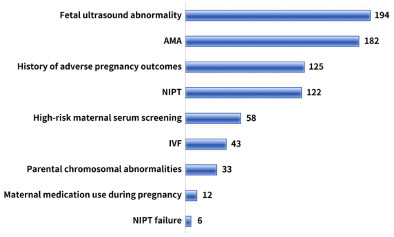
CNV-seq Type Indications 1 sseq[GRCh37]22q11.21q11.21(18920346_21630621) × 3 chr22:g.18920346_21630621dup Pathogenicity High risk in NIPT 2 sseq[GRCh37]22q11.21q11.21(18882825_21796237) × 3 chr22:g.18882825_21796237dup Pathogenicity Parental chromosomal abnormalities 3 sseq[GRCh37]22q11.21q11.22(21746118_22964181) × 1 chr22:g.21746118_22964181del Likely pathogenicity Ultrasonic abnormalities, history of adverse pregnancy outcomes 4 sseq[GRCh37]17q12q12(34513616_36299170) × 1 chr17:g.34513616_36299170del Pathogenicity Ultrasonic abnormalities 5 sseq[GRCh37]22q11.21q11.22(18815839_21657982) × 1 chr22:g.18815839_21657982del Pathogenicity Advanced maternal age, high risk in NIPT 6 sseq[GRCh37]22q11.21q11.22(18882825_21713868) × 3 chr22:g.18882825_21713868dup Pathogenicity High-risk maternal serum screening 7 sseq[GRCh37]Xp21.1p21.1(31517704_31746485) × 3 chrX: g.31517704_31746485dup Likely pathogenicity High risk in NIPT 8 sseq[GRCh37]16p13.11p13.11(15096074_16425849) × 1 chr16:g.15096074_16425849del Pathogenicity High risk in NIPT 9 sseq[GRCh37]17q12q12(34823326_36252160) × 1 chr17:g.34823326_36252160del Pathogenicity Ultrasonic abnormalities 10 sseq[GRCh37]22q11.21q11.21(18753368_21746118) × 3 chr22:g.18753368_21746118dup Pathogenicity Ultrasonic abnormalities 11 sseq[GRCh37]Xp21.1p21.1(32342723_32537601) × 2 chrX: g.32342723_32537601dup Likely pathogenicity Parental chromosomal abnormalities 12 sseq[GRCh37]7q11.23q11.23(7251946_74206383) × 1 chr7:g.7251946_74206383del Pathogenicity Ultrasonic abnormalities 13 sseq[GRCh37]5p15.33p13.2(10429_34499283) × 1 chr5:g.10429_34499283del Pathogenicity History of adverse pregnancy outcomes 14 sseq[GRCh37]15q11.2q11.2(22724377_23273260) × 1 chr15:g.22724377_23273260del Pathogenicity Parental chromosomal abnormalities 15 sseq[GRCh37]15q13.2q13.3(30920060_32491354) × 1 chr15:g.30920060_32491354del Pathogenicity Advanced maternal age, history of adverse pregnancy outcomes 16 sseq[GRCh37]15q11.2q13.1(22554928_28861789) × 3 chr15:g.22554928_28861789dup Pathogenicity Advanced maternal age 17 sseq[GRCh37]Xp21.1p21.1(31756813_31930826) × 0 chrX: g.31756813_31930826del Pathogenicity Parental chromosomal abnormalities 18 sseq[GRCh37]Yq11.223q11.23(24873130_28432569) × 0 chrY: g.24873130_28432569del Pathogenicity High-risk maternal serum screening 19 sseq[GRCh37]Xp21.1p21.1(32702698_32878270) × 0 chrX: g.32702698_32878270del Pathogenicity Ultrasonic abnormalities
下载: 导出CSV
Table 3. Comparison of detection results between CNV-seq and karyotype analysis
Abnormal Karyotype Number of Karyotyping Number of CNV-seq Number of Combined Detection Incremental Detection Gain (%) Chromosome Aneuploidy 39 39 39 0.00 Microduplications/Microdeletions 0 19 19 3.00 Chromosomal Mosaicism 11 5 11 0.95 Balanced Translocation 12 0 12 1.74 Unbalanced Translocation 8 8 8 0.00 Polymorphism 29 0 29 4.58 Total 99 71 118 7.42
下载: 导出CSV
-
[1] Yue W, Zhang E, Liu R, et al. The China birth cohort study (CBCS). Eur J Epidemiol, 2022; 37(3): 295-304. doi: 10.1007/s10654-021-00831-8 [2] Wapner R J, Martin C L, Levy B, et al. Chromosomal microarray versus karyotyping for prenatal diagnosis. N Engl J Med, 2012; 367(23): 2175-2184. doi: 10.1056/NEJMoa1203382 [3] Christiansen O B. Special issue recurrent pregnancy loss: Etiology, diagnosis, and therapy. J Clin Med, 2021; 10(21): 5040. doi: 10.3390/jcm10215040 [4] Xu J J, Hu Y, Liu W, et al. Combined application of low-pass whole genome sequencing and karyotyping in prenatal diagnosis of pregnant women with high risk in non-invasive prenatal testing. Acta Universitatis Medicinalis Anhui, 2021; 56(4): 619-623. [5] Kamath V, Purna Chacko M, Kirubakaran R, et al. Single nucleotide polymorphism array versus karyotype for prenatal diagnosis in fetuses with abnormal ultrasound: A systematic review and meta-analysis. Eur J Obstet Gynecol Reprod Biol, 2022; 271: 235-244. doi: 10.1016/j.ejogrb.2022.02.011 [6] Tenorio J, Nevado J, González-Meneses A, et al. Further definition of the proximal19p13.3 microdeletion/microduplication syndrome and implication of PIAS4 as the major contributor. Clin Genet, 2020; 97(3): 467-476. doi: 10.1111/cge.13689 [7] Xie C L, Chen M F, Chi L P, et al. Application value of copy number variation sequencing combined with chromosome karyotype analysis in prenatal diagnosis of amniotic fluid. Maternal & Child Health Care of China, 2024; 39(10): 1870-1874. [8] Aghajafari F, Nagulesapillai T, Ronksley P E, et al. Association between maternal serum 25-hydroxyvitamin D level and pregnancy and neonatal outcomes: Systematic review and meta-analysis of observational studies. BMJ, 2013; 346: f1169. doi: 10.1136/bmj.f1169 [9] Kudo E, Song E, Yockey L J, et al. Low ambient humidity impairs barrier function and innate resistance against influenza infection. Proc Natl Acad Sci U S A, 2019; 116(22): 10905-10910. doi: 10.1073/pnas.1902840116 [10] Moriyama M, Hugentobler W J, Iwasaki A. Seasonality of respiratory viral infections. Annu Rev Virol, 2020; 7(1): 83-101. doi: 10.1146/annurev-virology-012420-022445 [11] American College of Obstetricians and Gynecologists' Committee on Practice Bulletins—Obstetrics; Committee on Genetics; Society for Maternal-Fetal Medicine. Screening for fetal chromosomal abnormalities: ACOG practice bulletin, Number 226. Obstet Gynecol, 2020; 136(4): e48-e69. doi: 10.1097/AOG.0000000000004084 [12] Xu L, Zhang M, Huang H, et al. The comprehensive comparison of bacterial artificial chromosomes (BACs)-on-beads assay and copy number variation sequencing in prenatal diagnosis of Southern Chinese women. J Mol Diagn, 2020; 22(11): 1324-1332. doi: 10.1016/j.jmoldx.2020.07.005 [13] Wang J, Chen L, Zhou C, et al. Prospective chromosome analysis of 3429 amniocentesis samples in China using copy number variation sequencing. Am J Obstet Gynecol, 2018; 219(3): 287.e1-287.e18. doi: 10.1016/j.ajog.2018.05.030 [14] Zhao M, Wang Q, Wang Q, et al. Computational tools for copy number variation (CNV) detection using next-generation sequencing data: Features and perspectives. BMC Bioinformatics, 2013; 14 Suppl 11(Suppl 11): S1. [15] Liu S, Song L, Cram D S, et al. Traditional karyotyping vs copy number variation sequencing for detection of chromosomal abnormalities associated with spontaneous miscarriage. Ultrasound Obstet Gynecol, 2015; 46(4): 472-477. doi: 10.1002/uog.14849 [16] Cohen K, Tzika A, Wood H, et al. Diagnosis of fetal submicroscopic chromosomal abnormalities in failed array CGH samples: Copy number by sequencing as an alternative to microarrays for invasive fetal testing. Ultrasound Obstet Gynecol, 2015; 45(4): 394-401. doi: 10.1002/uog.14767 [17] Wang Y, Chen Y, Tian F, et al. Maternal mosaicism is a significant contributor to discordant sex chromosomal aneuploidies associated with noninvasive prenatal testing. Clin Chem, 2014; 60(1): 251-259. doi: 10.1373/clinchem.2013.215145 [18] Goodwin J, McCormack L, Campbell L E. "You don't know until you get there": The positive and negative "lived" experience of parenting an adult child with 22q11.2 deletion syndrome. Health Psychol, 2017; 36(1): 45-54. doi: 10.1037/hea0000415 [19] Kosugi S, Momozawa Y, Liu X, et al. Comprehensive evaluation of structural variation detection algorithms for whole genome sequencing. Genome Biol, 2019; 20(1): 117. doi: 10.1186/s13059-019-1720-5 [20] Levy B, Kanagal-Shamanna R, Sahajpal N S, et al. A framework for the clinical implementation of optical genome mapping in hematologic malignancies. Am J Hematol, 2024; 99(4): 642-661. doi: 10.1002/ajh.27175 -
 fzm-6-2-109_ESM6.docx
 fzm-6-2-109_ESM1.docx
fzm-6-2-109_ESM3.pdf
fzm-6-2-109_ESM4.pdf
fzm-6-2-109_ESM2.pdf
fzm-6-2-109_ESM7.docx
fzm-6-2-109_ESM5.docx
fzm-6-2-109_ESM8.docx
fzm-6-2-109_ESM1.docx
fzm-6-2-109_ESM3.pdf
fzm-6-2-109_ESM4.pdf
fzm-6-2-109_ESM2.pdf
fzm-6-2-109_ESM7.docx
fzm-6-2-109_ESM5.docx
fzm-6-2-109_ESM8.docx
-

 点击查看大图
图(2) / 表(3)
计量
- 文章访问数: 103
- HTML全文浏览量: 54
- PDF下载量: 0
- 被引次数: 0