投稿系统
投稿系统


Impact of non-optimal temperatures on ischemic heart disease: A comparative analysis between global SDI regions and China, 1990-2021
doi: 10.1515/fzm-2026-0008
-
Abstract:
Background Non-optimal temperatures contribute substantially to ischemic heart disease (IHD) risk; however, comparative trends and determinants of the dual burdens associated with heat and cold exposure remain poorly understood, especially in China. This study compared the temperature-attributable burden of IHD in China with global and Socio-Demographic Index (SDI)-stratified patterns from 1990 to 2021 to identify major disparities. Methods Using data from the Global Burden of Disease 2021 study, we analyzed trends in temperature-attributable IHD trends via decomposition analysis, Joinpoint regression, and age-period-cohort modeling. Future trends through 2031 were projected using a Bayesian model. Results Globally, the age-standardized mortality rate (ASMR) attributable to non-optimal temperatures declined by 30.09%, primarily driven by reductions in the low-temperature burden. However, these improvements were largely confined to high-SDI regions, while lower-SDI regions experienced stagnant or worsening trends. In contrast, China demonstrated a 15.65% increase in overall ASMR, driven by a dual burden characterized by a marked rise in heat-related ASMR (+64.15%) and a concurrent increase in cold-related ASMR (+12.18%). Decomposition analysis identified fundamentally different driving forces between global and Chinese trends. Globally, epidemiological improvements exerted a strong protective effect (-256.56%), whereas in China, these factors contributed to an increase in per-capita risk (+169.82%). Projections to 2031 suggest these disparities are likely to persist. Conclusion China is facing a compounding IHD crisis driven by the combined impacts of both heat and cold exposure, representing a risk profile that differs fundamentally from global patterns. These findings highlight the urgent need for a paradigm shift toward tailored, dual-target public health strategies capable of simultaneously mitigating the adverse cardiovascular effects of both temperature extremes in vulnerable populations. -
Key words:
- ischemic heart disease /
- temperature exposure /
- global burden of disease
-

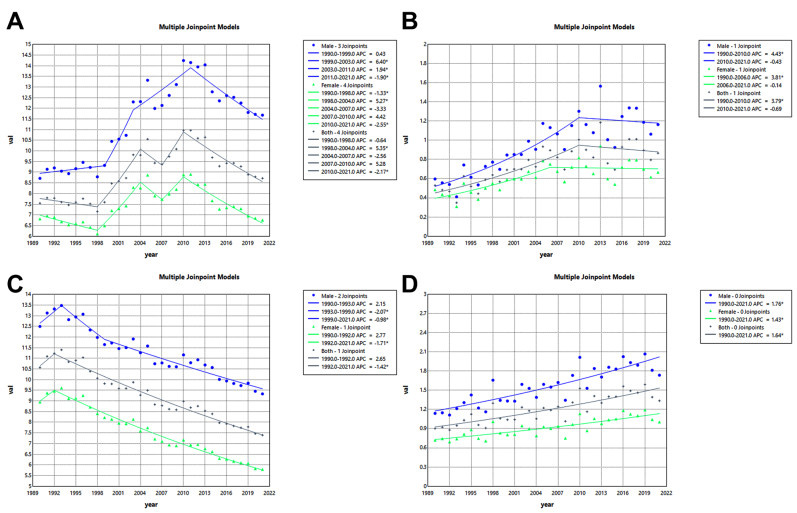
Figure 1. Joinpoint regression analysis of sex-specific ASMR for IHD attributable to temperature exposure in China and globally from 1990 to 2021
(A) Non-optimal temperature exposure in China. (B) High temperature exposure in China. (C) Non-optimal temperature exposure globally. (D) High temperature exposure globally. Filled circles (●) represent observed annual ASMRs per 100,000 population. Solid lines indicate fitted trends derived from the Joinpoint regression model, with each segment representing a period of statistically significant change. IHD, Ischemic heart disease; ASMR, age-standardized mortality rate; APC, age-period-cohort.

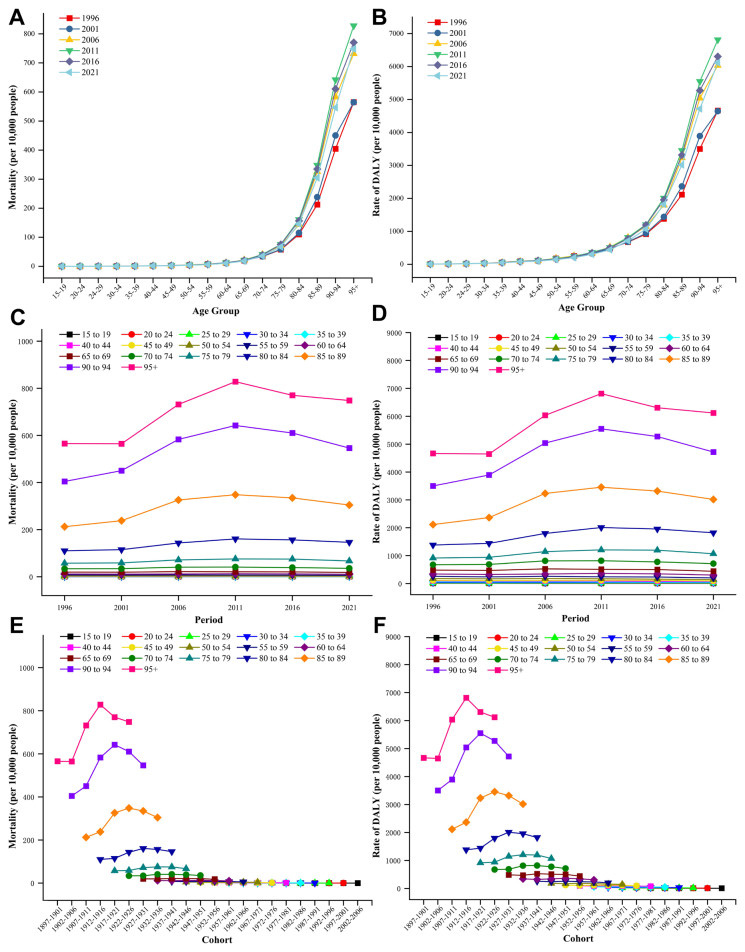
Figure 2. Age, period, and cohort effects on mortality and DALY rates of IHD attributable to non-optimal temperatures in China
(A-B) Age-specific relative risks for IHD mortality and DALY rates. (C-D) Period effects on IHD mortality and DALY rates; (E-F) Cohort effects on IHD mortality and DALY rates. IHD, Ischemic heart disease; DALY, disability-adjusted life year.

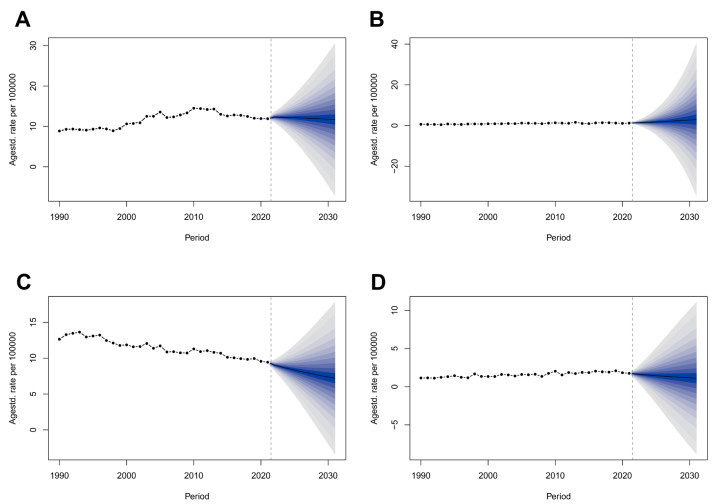
Figure 3. Projected ASMR per 100,000 population for IHD attributable to non-optimal temperatures among males from 1990 to 2031
(A) Non-optimal temperature exposure in China. (B) High temperature exposure in China. (C) Non-optimal temperature exposure globally. (D) High temperature exposure globally. The solid lines represent posterior mean estimates derived from the BAPC model. The fan-shaped shaded area indicates the 95% credible intervals, reflecting increasing uncertainty in future projections. The vertical dashed lines separate the historical observation period (1990-2021) from the forecast period (2022-2031). IHD, ischemic heart disease; ASMR, age-standardized mortality rate.
-
[1] Xu X, Liu C, Liu R, et al. Extreme temperature increases the severity of intracerebral hemorrhage: An analysis based on the cold region of China. Frigid Zone Med, 2022; 2(3): 178-185. doi: 10.2478/fzm-2022-0024 [2] Anikeeva O, Hansen A, Varghese B, et al. The impact of increasing temperatures due to climate change on infectious diseases. BMJ, 2024; 387: e79343. [3] Liu J, Li M, Yang Z, et al. Rising trend and regional disparities of the global burden of disease attributable to ambient low temperature, 1990-2019: An analysis of data from the Global Burden of Disease 2019 study. J Glob Health, 2024; 14: 4017. doi: 10.7189/jogh.14.04017 [4] Van Daalen K R, Wyma N, Schauer-Berg J, et al. The global health community at international climate change negotiations. BMJ Global Health, 2024; 9(4): e15292. [5] Mavrodaris A. Climate change and emerging infections: Risks, adaptation and response. Euro J Public Health, 2024; 34(Supplement 3): ckae144-ckae475. [6] Zhang H, Zheng X, Huang P, et al. The burden and trends of heart failure caused by ischaemic heart disease at the global, regional, and national levels from 1990 to 2021. Eur Heart J Qual Care Clin Outcomes, 2025; 11(2): 186-196. doi: 10.1093/ehjqcco/qcae094 [7] Naghavi M, Ong K L, Aali A, et al. Global burden of 288 causes of death and life expectancy decomposition in 204 countries and territories and 811 subnational locations, 1990-2013;2021: A systematic analysis for the Global Burden of Disease Study 2021. Lancet, 2024; 403(10440): 2100-2132. doi: 10.1016/S0140-6736(24)00367-2 [8] Li Y, Zhang J. Disease burden and risk factors of ischemic heart disease in China during 1990-2019 based on the Global Burden of Disease 2019 report: A systematic analysis. Front Public Health, 2022; 10: 973317. doi: 10.3389/fpubh.2022.973317 [9] Kazi D S, Katznelson E, Liu C, et al. Climate change and cardiovascular health. JAMA Cardiol, 2024; 9(8): 748. doi: 10.1001/jamacardio.2024.1321 [10] Münzel T, Khraishah H, Schneider A, et al. Challenges posed by climate hazards to cardiovascular health and cardiac intensive care: implications for mitigation and adaptation. Euro Heart J, 2024; 13(10): 731-744. [11] Barry H, Iglesies-Grau J, Chaseling G K, et al. The effect of heat exposure on myocardial blood flow and cardiovascular function. Ann Intern Med, 2024; 177(7): 901-910. doi: 10.7326/M24-3504 [12] Guallar E, Bravo P E, Ferrari V A. Feeling the heat: Cardiovascular consequences of heat exposure under controlled experimental conditions. Ann Intern Med, 2024; 177(7): 976-977. doi: 10.7326/M24-0882 [13] Ou Y, Wang F, Zhao J, et al. Risk of heatstroke in healthy elderly during heatwaves: A thermoregulatory modeling study. Build Environ, 2023; 237: 110324. doi: 10.1016/j.buildenv.2023.110324 [14] Lerman B, Lerman L O. "Nothing burns like the cold": Cardiovascular disease in frigid zones. Frigid Zone Med, 2022; 2(3): 129-131. doi: 10.2478/fzm-2022-0017 [15] Xu R, Huang S, Shi C, et al. Extreme temperature events, fine particulate matter, and myocardial infarction mortality. Circulation, 2023; 148(4): 312-323. doi: 10.1161/CIRCULATIONAHA.122.063504 [16] Cheng B, Li T, Li H, et al. Short-term effects of cold spells on hematocrit among adults in Nanjing, China: A distributed-lagged effect analysis. Sci Total Environ, 2023; 892: 164469. doi: 10.1016/j.scitotenv.2023.164469 [17] Murray C J L, Aravkin A Y, Zheng P, et al. Global burden of 87 risk factors in 204 countries and territories, 1990-2019: A systematic analysis for the Global Burden of Disease Study 2019. Lancet, 2020; 396(10258): 1223-1249. doi: 10.1016/S0140-6736(20)30752-2 [18] Zhao Q, Guo Y, Ye T, et al. Global, regional, and national burden of mortality associated with non-optimal ambient temperatures from 2000 to 2019: a three-stage modelling study. Lancet Planet Health, 2021; 5(7): e415-e425. doi: 10.1016/S2542-5196(21)00081-4 [19] Johnson N P, Del F A, Nori-Sarma A, et al. Metrics of urbanicity and rurality in US-based epidemiologic studies of ambient temperature and health: A scoping review. Curr Environ Health Rep, 2025; 12(1): 30. doi: 10.1007/s40572-025-00494-7 [20] Errett N A, Dolan K, Hartwell C, et al. Climate change adaptation activities and needs in US state and territorial health agencies. J Public Health Manag Pract, 2023; 29(3): E115-E123. doi: 10.1097/PHH.0000000000001674 [21] Budin-Ljøsne I, Nordeng Z, Schwarze P E, et al. Linking climate change adaptation and public health: Perspectives of Norwegian policymakers. Scand J Public Health, 2025; 53(2): 125-133. doi: 10.1177/14034948241229486 [22] Shang J, Zhao M, Liu Z, et al. Community-level practice checklists for health protection during cold spells in China. China CDC Wkly, 2024; 6(5): 83-87. doi: 10.46234/ccdcw2024.018 [23] Zhang G, Liu C, Sun Q. The impact of low ambient temperature on cardiovascular health. Frigid Zone Med, 2023; 3(3): 167-175. doi: 10.2478/fzm-2023-0021 [24] Ma G, Cai H, Li Z, et al. Advancements in understanding inflammatory responses and the development of cardiovascular diseases under cold stimulation. Frigid Zone Med, 2023; 3(4): 209-215. doi: 10.2478/fzm-2023-0028 [25] He C, Yin P, Liu Z, et al. Projections of excess deaths related to cold spells under climate and population change scenarios: A nationwide time series modeling study. Environ Int, 2023; 178: 108034. doi: 10.1016/j.envint.2023.108034 [26] Xie Y, Zhou Z, Sun Q, et al. Social-economic transitions and vulnerability to extreme temperature events from 1960 to 2020 in Chinese cities. IScience, 2024; 27(3): 109066. doi: 10.1016/j.isci.2024.109066 [27] Li D, Hu Y, Pfaff H, et al. Determinants of patients' intention to use the online inquiry services provided by internet hospitals: Empirical evidence from China. J Med Internet Res, 2020; 22(10): e22716. doi: 10.2196/22716 [28] Shi X, Wang L, Dai Z, et al. Policy interpretation of the China National Climate Change Health Adaptation Action Plan (2024-2030). China CDC Wkly, 2025; 7(12): 385-388. doi: 10.46234/ccdcw2025.063 [29] Cornu T, Marchal B, Renmans D. How do urban green spaces influence heat-related mortality in elderly? A realist synthesis. BMC Public Health, 2024; 24(1): 457. doi: 10.1186/s12889-024-17973-5 [30] Ho J Y, Shi Y, Lau K, et al. Urban heat island effect-related mortality under extreme heat and non-extreme heat scenarios: A 2010-2019 case study in Hong Kong. Sci Total Environ, 2023; 858(Pt 1): 159791. [31] Feng T, Ma J, Yang Y, et al. Synergistic effects of air pollution control policies: Evidence from China. J Environ Manage, 2025; 373: 123581. doi: 10.1016/j.jenvman.2024.123581 [32] Shi Y, Li N, Li Z, et al. Impact of comprehensive air pollution control policies on six criteria air pollutants and acute myocardial infarction morbidity, Weifang, China: A quasi-experimental study. Sci Total Environ, 2024; 922: 171206. doi: 10.1016/j.scitotenv.2024.171206 [33] He G, Jiang M, Tian S, et al. Clean air policy reduces the atherogenic lipid profile levels: Results from China Health Evaluation And risk Reduction through nationwide Teamwork (ChinaHEART) Study. J Hazard Mater, 2024; 478: 135394. doi: 10.1016/j.jhazmat.2024.135394 [34] Chinese Society of Cardiology of Chinese Medical Association, Cardiovascular Disease Prevention and Rehabilitation Committee of Chinese Association of Rehabilitation Medicine, Cardiovascular Disease Committee of Chinese Association of Gerontology and Geriatrics, et al. Chinese guideline on the primary prevention of cardiovascular diseases. Zhonghua Xin Xue Guan Bing Za Zhi, 2020; 48(12): 1000-1038. [35] Zhou T Y. More people will enjoy free public health services in China-China Court. [Accessed on 2025-06-09]. https://www.chinacourt.cn/article/detail/2011/05/id/451706.shtml .[36] Shi G, Liu J, Zhong X. Spatial and temporal variations of PM (2.5) concentrations in Chinese cities during 2015-2019. Int J Environ Health Res, 2022; 32(12): 2695-2707. doi: 10.1080/09603123.2021.1987394 [37] Wang Y, Gao W, Wang S, et al. Contrasting trends of PM (2.5) and surface-ozone concentrations in China from 2013 to 2017. Natl Sci Rev, 2020; 7(8): 1331-1339. doi: 10.1093/nsr/nwaa032 -
 fzm-6-2-76_ESM.docx

-

 下载:
下载:
 点击查看大图
计量
- 文章访问数: 84
- HTML全文浏览量: 48
- PDF下载量: 3
- 被引次数: 0