投稿系统
投稿系统


Association between ambient temperature variability and ST-segment elevation myocardial infarction in cold regions, China: A time-series analysis
doi: 10.1515/fzm-2026-0007
-
Abstract:
Objective This study investigated the impact of daily ambient temperature and temperature changes between neighboring days (TCN) on the risk of ST-segment elevation myocardial infarction (STEMI) in cold regions using a time-series approach. Methods From January 1, 2017 to December 31, 2020, STEMI cases were collected from the largest medical center in Heilongjiang Province, excluding patients with incomplete data or unclear symptom onset times. Meteorological variables and air pollutant data corresponding to patients' residential address were matched from nearby monitoring stations. A distributed lag nonlinear model (DLNM) with a lag period of 0-21 days was applied to assess the effects of suboptimal temperatures on STEMI risk and lag structures. Different temperature indicators (maximum, mean, minimum, and TCN) were compared, and subgroup analyses by sex and age were performed to evaluate population-specific susceptibility. Results A total of 1461 days were included, comprising 4700 STEMI cases. Cold exposure was associated with a significant increase in STEMI incidence, with a delayed onset of 3 days and a prolonged effect lasting up to 20 days. In contrast, the heat effect was immediate and persisted for approximately 3 days. In the 21-day cumulative relative risk (CRR) analysis, using a median temperature of 6.6 ℃, the minimum morbidity temperature was identified at 17 ℃ (CRR 0.709, 95% CI 0.345-1.457). Notably, the highest incidence did not occur at the lowest temperature (-29 ℃, CRR 1.201, 95% CI 0.273-5.273). Instead, STEMI risk increased as temperatures rose from extreme cold, reaching a peak at -10 ℃ (CRR 1.63, 95% CI 0.905-2.936). Under conditions of extreme cooling (TCN = -11 ℃), STEMI risk increased from lag 0 to 7 (relative risk [RR] 2.239, 95% CI 0.279-17.936). Conclusions In cold regions, extreme temperatures, especially sustained cold exposure, significantly increase the risk of STEMI. Rapid temperature drops between consecutive days further elevate incidence, highlighting the importance of both absolute temperature and short-term temperature variability in cardiovascular risk. -

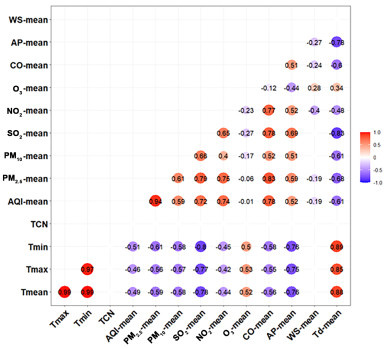
Figure 1. Spearman correlation coefficient among environmental factors
WS, wind speed; AP, atmospheric pressure; AQI, air quality index; TCN, temperature changes between neighboring days; Td, dew point temperature.

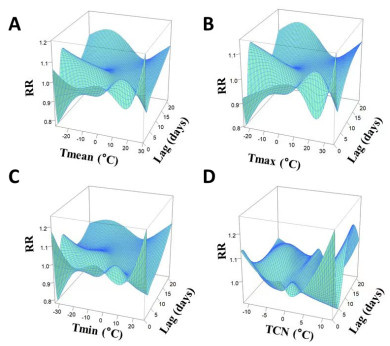
Figure 2. Three-dimensional exposure-lag-response surfaces of temperature indicators and ST-segment elevation myocardial infarction (STEMI) incidence in the overall population
(A)Tmean. (B) Tmax. (C) Tmin. (D) TCN. RR, relative risk; TCN, temperature changes between neighboring days.

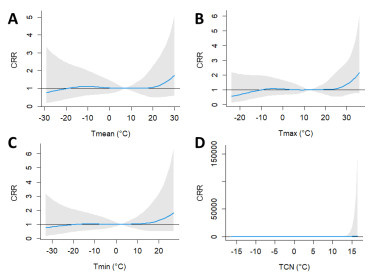
Figure 3. Cumulative relative risk of ST-segment elevation myocardial infarction (STEMI) incidence across different temperature indicators in the overall population
(A) Tmean. (B) Tmax. (C) Tmin. (D) TCN. CRR, cumulative relative risk. The blue line represents the estimated relative risk, and the gray shaded area indicates the 95% confidence interval.

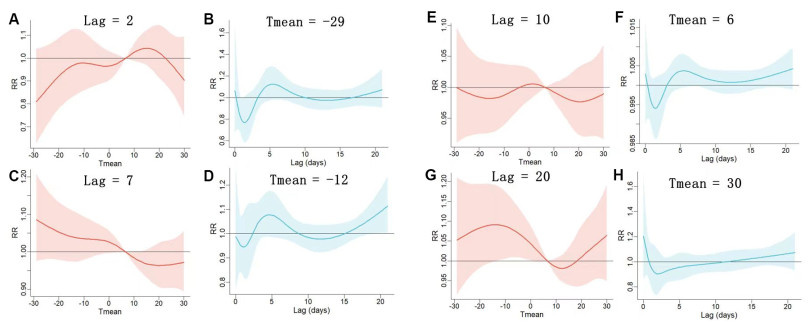
Figure 4. Lag-response relationship between mean temperature (Tmean) and ST-segment elevation myocardial infarction (STEMI) incidence in the overall population
(A) The relative risk of STEMI after lag 2 days at the average temperature level. (B) The relative risk of having a STEMI at average temperatures of -29 ℃ over the same range of lag days. (C) The relative risk of STEMI after lag 7 days at the average temperature level. (D) The relative risk of having a STEMI at average temperatures of -12 ℃ over the same range of lag days. (E) The relative risk of STEMI after lag 10 days at the average temperature level. (F) The relative risk of having a STEMI at average temperatures of 6 ℃ over the same range of lag days. (G) The relative risk of STEMI after lag 20 days at the average temperature levely. (H) The relative risk of having a STEMI at average temperatures of 30 ℃ over the same range of lag days. RR, relative risk.

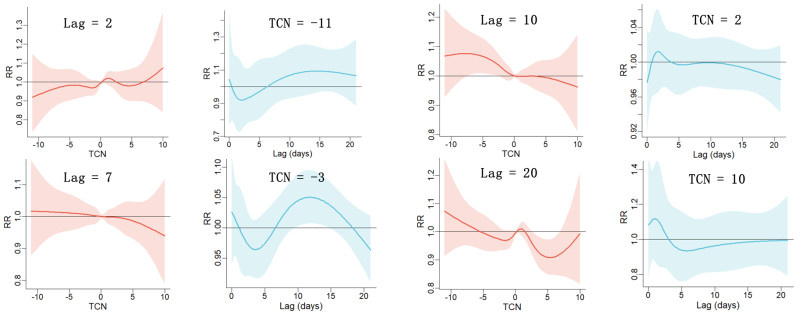
Figure 5. Lag-response relationship between inter-day TCN and STEMI incidence in the overall population
TCN, temperature changes between neighboring days; STEMI, ST-segment elevation myocardial infarction; RR, relative risk.

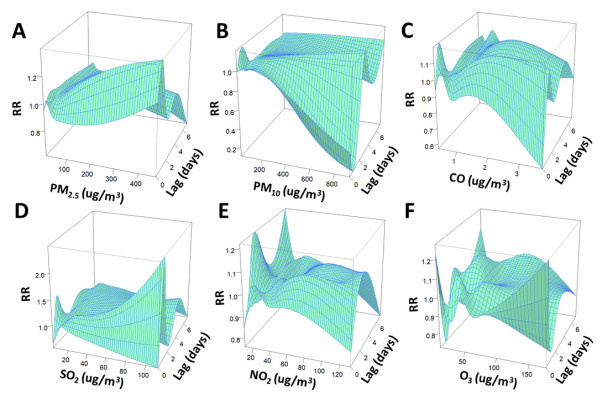
Figure 6. Three-dimensional exposure-lag-response surfaces of six major air pollutants and STEMI incidence in the overall population
(A) PM2.5. (B) PM10. (C) CO. (D) SO2. (E) NO2. (F) O3. STEMI, ST-segment elevation myocardial infarction; RR, relative risk.
Table 1. Descriptive statistics of daily meteorological variables and air pollutant concentrations in Harbin, China (2017-2020)
Variable Mean SD Min Q1 Median Q3 Max Tmean (℃) 5.16 15.21 -29.38 -9.41 7.25 18.80 30.43 Tmax (℃) 9.58 15.09 -24.20 -4.80 12.70 23.20 36.80 Tmin (℃) 0.52 15.69 -33.40 -14.40 2.20 14.90 27.20 TCN (℃) 0 3.60 -16.66 -1.96 0.15 2.18 16.54 AP (kPa) 101.25 3.64 37.68 100.63 101.39 102.24 104.29 WS (m/s) 29.73 12.07 7.50 21.25 27.50 36.25 92.50 Td (℃) -1.52 15.10 -34.08 -14.66 -2.29 12.36 25.23 AQI 71.01 57.55 10.00 36.79 53.29 81.25 442.29 PM2.5 (μg/m3) 46.12 56.28 4.38 15.54 27.57 53.46 925.71 PM10 (μg/m3) 55.63 60.43 4.38 20.33 38.21 68.25 923.70 SO2 (μg/m3) 19.79 15.81 4.00 8.83 13.04 26.04 112.38 NO2 (μg/m3) 36.18 16.43 9.04 24.50 32.58 43.96 132.21 O3 (μg/m3) 55.28 24.95 7.50 35.43 52.75 69.58 179.79 CO (μg/m3) 0.84 0.41 0.36 0.57 0.70 0.95 3.72 AP, air pressure; WS, wind speed; Td, dew point temperature; AQI, air quality index; TCN, temperature changes between neighboring days; Mean, mean value; SD, standard deviation; Min, minimum value; Q1 and Q3, first and third quartiles (25th and 75th percentiles, respectively); Max, maximum value. Pollutant values represent daily average concentrations.  下载: 导出CSV
-
[1] Vos T, Lim S S, Abbafati C, et al. Global burden of 369 diseases and injuries in 204 countries and territories, 1990-2019: A systematic analysis for the Global Burden of Disease Study 2019. Lancet, 2020; 396(10258): 1204-1222. doi: 10.1016/S0140-6736(20)30925-9 [2] Roth G A, Mensah G A, Johnson C O, et al. Global burden of cardiovascular diseases and risk factors, 1990-2019: update from the GBD 2019 study. J Am Coll Cardiol, 2020; 76(25): 2982-3021. doi: 10.1016/j.jacc.2020.11.010 [3] Mensah G A, Roth G A, Fuster V. The global burden of cardiovascular diseases and risk factors: 2020 and beyond. J Am Coll Cardiol, 2019; 74(20): 2529-2532. doi: 10.1016/j.jacc.2019.10.009 [4] Murray C J, Aravkin A Y, Zheng P, et al. Global burden of 87 risk factors in 204 countries and territories, 1990-2019: A systematic analysis for the Global Burden of Disease Study 2019. Lancet, 2020; 396(10258): 1223-1249. doi: 10.1016/S0140-6736(20)30752-2 [5] Bhaskaran K, Hajat S, Haines A, et al. Effects of ambient temperature on the incidence of myocardial infarction. Heart, 2009; 95(21): 1760-1769. doi: 10.1136/hrt.2009.175000 [6] Claeys M J, Rajagopalan S, Nawrot T S, et al. Climate and environmental triggers of acute myocardial infarction. European Heart Journal, 2017; 38(13): 955-960. [7] Basu R. High ambient temperature and mortality: A review of epidemiologic studies from 2001 to 2008. Environmental Health, 2009; 8: 1-13. [8] Turner L R, Barnett A G, Connell D, et al. Ambient temperature and cardiorespiratory morbidity: A systematic review and meta-analysis. Epidemiology, 2012; 23(4): 594-606. doi: 10.1097/EDE.0b013e3182572795 [9] Bhaskaran K, Hajat S, Haines A, et al. Short term effects of temperature on risk of myocardial infarction in England and Wales: Time series regression analysis of the Myocardial Ischaemia National Audit Project (MINAP) registry. BMJ, 2010; 341: c3823. doi: 10.1136/bmj.c3823 [10] Danet S, Richard F, Montaye M, et al. Unhealthy effects of atmospheric temperature and pressure on the occurrence of myocardial infarction and coronary deaths: A 10-year survey: The Lille-World Health Organization MONICA project (Monitoring trends and determinants in cardiovascular disease). Circulation, 1999; 100(1): e1-e7. [11] Wichmann J, Ketzel M, Ellermann T, et al. Apparent temperature and acute myocardial infarction hospital admissions in Copenhagen, Denmark: A case-crossover study. Environmental Health, 2012; 11: 1-12. [12] Wolf K, Schneider A, Breitner S, et al. Air temperature and the occurrence of myocardial infarction in Augsburg, Germany. Circulation, 2009; 120(9): 735-742. doi: 10.1161/CIRCULATIONAHA.108.815860 [13] Chen K, Breitner S, Wolf K, et al. Temporal variations in the triggering of myocardial infarction by air temperature in Augsburg, Germany, 1987-2014. Euro Heart J, 2019; 40(20): 1600-1608. doi: 10.1093/eurheartj/ehz116 [14] Bhaskaran K, Armstrong B, Hajat S, et al. Heat and risk of myocardial infarction: Hourly level case-crossover analysis of MINAP database. BMJ, 2012; 345: e8050. doi: 10.1136/bmj.e8050 [15] Madrigano J, Mittleman M A, Baccarelli A, et al. Temperature, myocardial infarction, and mortality: Effect modification by individual-and area-level characteristics. Epidemiology, 2013; 24(3): 439-446. doi: 10.1097/EDE.0b013e3182878397 [16] Cheng J, Su H, Xu Z, et al. Extreme temperature exposure and acute myocardial infarction: Elevated risk within hours? Environ Res, 2021; 202: 111691. doi: 10.1016/j.envres.2021.111691 [17] Liu X, Kong D, Fu J, et al. Association between extreme temperature and acute myocardial infarction hospital admissions in Beijing, China: 2013-2016. PLoS One, 2018; 13(10): e0204706. doi: 10.1371/journal.pone.0204706 [18] Sun Z, Chen C, Xu D, et al. Effects of ambient temperature on myocardial infarction: A systematic review and meta-analysis. Environ Pollut, 2018; 241: 1106-1114. doi: 10.1016/j.envpol.2018.06.045 [19] Versaci F, Biondi-Zoccai G, Dei Giudici A, et al. Climate changes and ST-elevation myocardial infarction treated with primary percutaneous coronary angioplasty. Inte J Cardiol, 2019; 294: 1-5. [20] Gasparrini A, Armstrong B, Kenward M G. Distributed lag non-linear models. Stat Med, 2010; 29(21): 2224-2234. doi: 10.1002/sim.3940 [21] Thygesen K, Alpert J S, Jaffe A S, et al. Fourth universal definition of myocardial infarction (2018). Circulation, 2018; 138(20): e618-e651. [22] Chinese Society of Cardiology of Chinese Medical Association, Editorial Board of Chinese Journal of Cardiology. 2019 Chinese Society of Cardiology (CSC) guidelines for the diagnosis and management of patients with ST-segment elevation myocardial infarction [Chinese]. Zhonghua Xin Xue Guan Bing Za Zhi, 2019; 47(10): 766-783. [23] Chen J, Gao Y, Jiang Y, et al. Low ambient temperature and temperature drop between neighbouring days and acute aortic dissection: A case-crossover study. Euro Heart J, 2022; 43(3): 228-235. doi: 10.1093/eurheartj/ehab803 [24] Goggins W B, Woo J, Ho S, et al Weather, season, and daily stroke admissions in Hong Kong. Int J Biometeorol, 2012; 56: 865-872. doi: 10.1007/s00484-011-0491-9 [25] Stout R W, Crawford V. Seasonal variations in fibrinogen concentrations among elderly people. Lancet, 1991; 338(8758): 9-13. doi: 10.1016/0140-6736(91)90004-9 [26] Armstrong B G, Gasparrini A, Tobias A. Conditional Poisson models: A flexible alternative to conditional logistic case cross-over analysis. BMC Med Res Methodol, 2014; 14: 1-6. [27] Dang T A T, Wraith D, Bambrick H, et al. Short-term effects of temperature on hospital admissions for acute myocardial infarction: A comparison between two neighboring climate zones in Vietnam. Environ Res, 2019; 175: 167-177. doi: 10.1016/j.envres.2019.04.023 [28] Chen R, Yin P, Wang L, et al. Association between ambient temperature and mortality risk and burden: Time series study in 272 main Chinese cities. BMJ, 2018; 363: k4306. [29] Guo Y, Barnett A G, Pan X, et al. The impact of temperature on mortality in Tianjin, China: A case-crossover design with a distributed lag nonlinear model. Environ Health Perspect, 2011; 119(12): 1719-1725. doi: 10.1289/ehp.1103598 [30] Gasparrini A, Armstrong B. Reducing and meta-analysing estimates from distributed lag non-linear models. BMC Med Res Methodol, 2013; 13: 1. [31] Gasparrini A. Distributed lag linear and non-linear models in R: The package dlnm. J Stat Softw, 2011; 43: 1-20. [32] Jiang Y, Hu J, Peng L, et al. Non-optimum temperature increases risk and burden of acute myocardial infarction onset: A nationwide case-crossover study at hourly level in 324 Chinese cities. EClinicalMedicine, 2022; 50: 101501. doi: 10.1016/j.eclinm.2022.101501 [33] Zhai G, Qi J, Chai G. Impact of diurnal temperature range on cardiovascular disease hospital admissions among Chinese farmers in Dingxi (the Northwest China). BMC Cardiovasc Disord, 2021; 21(1): 252. doi: 10.1186/s12872-021-02065-8 [34] Jiang Y, Hu J, Peng L, et al. Non-optimum temperature increases risk and burden of acute myocardial infarction onset: A nationwide case-crossover study at hourly level in 324 Chinese cities. EClinicalMedicine, 2022; 50: 101501. doi: 10.1016/j.eclinm.2022.101501 [35] Ni W, Stafoggia M, Zhang S, et al. Short-term effects of lower air temperature and cold spells on myocardial infarction hospitalizations in Sweden. J Am Coll Cardiol, 2024; 84(13): 1149-1159. doi: 10.1016/j.jacc.2024.07.006 [36] Schwartz J, Samet J M, Patz J A. Hospital admissions for heart disease: The effects of temperature and humidity. Epidemiology, 2004; 15(6): 755-761. doi: 10.1097/01.ede.0000134875.15919.0f [37] Bayentin L, El Adlouni S, Ouarda T B, et al. Spatial variability of climate effects on ischemic heart disease hospitalization rates for the period 1989-2006 in Quebec, Canada. Int J Health Geogr, 2010; 9: 1-10. [38] Morabito M, Crisci A, Grifoni D, et al. Winter air-mass-based synoptic climatological approach and hospital admissions for myocardial infarction in Florence, Italy. Environ Res, 2006; 102(1): 52-60. doi: 10.1016/j.envres.2005.12.007 [39] Panagiotakos D B, Chrysohoou C, Pitsavos C, et al. Climatological variations in daily hospital admissions for acute coronary syndromes. Int J Cardiol, 2004; 94(2/3): 229-233. [40] Keatinge W, Coleshaw S, Cotter F, et al. Increases in platelet and red cell counts, blood viscosity, and arterial pressure during mild surface cooling: factors in mortality from coronary and cerebral thrombosis in winter. Br Med J (Clin Res Ed), 1984; 289(6456): 1405-1408. doi: 10.1136/bmj.289.6456.1405 [41] Thompson S G, Kienast J, Pyke S D, et al. Hemostatic factors and the risk of myocardial infarction or sudden death in patients with angina pectoris. N Engl J Med, 1995; 332(10): 635-641. doi: 10.1056/NEJM199503093321003 [42] Woodhouse P, Khaw K, Plummer M, et al. Seasonal variations of plasma fibrinogen and factor Ⅶ activity in the elderly: Winter infections and death from cardiovascular disease. Lancet, 1994; 343(8895): 435-439. doi: 10.1016/S0140-6736(94)92689-1 [43] O'Neill M S, Zanobetti A, Schwartz J. Modifiers of the temperature and mortality association in seven US cities. Am J Epidemiol, 2003; 157(12): 1074-1082. doi: 10.1093/aje/kwg096 [44] Fan J F, Xiao Y C, Feng Y F, et al. A systematic review and meta-analysis of cold exposure and cardiovascular disease outcomes. Front Cardiovasc Med, 2023; 10: 1084611. doi: 10.3389/fcvm.2023.1084611 [45] Cheng J, Su H, Xu Z, et al. Extreme temperature exposure and acute myocardial infarction: Elevated risk within hours? Environ Res, 2021; 202: 111691. doi: 10.1016/j.envres.2021.111691 -

 点击查看大图
计量
- 文章访问数: 102
- HTML全文浏览量: 60
- PDF下载量: 3
- 被引次数: 0